Short answer: travelling solo by train in Europe is statistically very safe — the real risk is almost never assault, it's opportunistic theft: a bag left in the luggage rack at the end of the carriage, a phone sitting on the tray table during a stop, a suitcase swept up in the rush to get off. The three critical moments are the ten minutes before and after a station stop, sleeping in a shared berth, and connecting platforms late in the evening. Three habits cover 90% of the risk: keep your documents and money on your body and never in your luggage, secure your suitcase to the luggage rack or the foot of the bunk, and book a seat or berth rather than dozing haphazardly in a lounge car.
Travelling alone by train is the finest way to cross Europe and also the one that demands the most self-reliance: nobody to watch your things while you go to the toilet, nobody to wake you at Verona at 4:12 a.m., nobody to talk to the conductor when your wallet has vanished. This article isn't meant to frighten you — the figures are reassuring — but to turn a vague, exhausting watchfulness into a simple routine that finally lets you sleep.
1. What the figures actually say
Let's put things back in perspective. Along with flying, the train is the safest land-based way to travel in Europe: the European Union Agency for Railways (ERA) publishes annual safety indicators that place rail far ahead of the road in terms of victims per billion passenger-kilometres. Violent crime on board remains rare and highly localised.
Opportunistic petty crime, on the other hand, is well documented. In France, the Service statistique ministériel de la sécurité intérieure (SSMSI) and the reports of the SUGE (SNCF rail security) describe the same profile year after year: thefts without violence, concentrated in major stations and busy trains, targeting phones, laptops, wallets and handbags. In Italy, the Polizia Ferroviaria (Polfer) regularly focuses on Rome Termini, Milan Centrale and Naples. In Spain, the area around Barcelona Sants and the Rodalies trains are classic hotspots. The cities you'll be warned about most — Barcelona, Rome, Paris, Naples, Brussels-Midi, Milan — are the ones that combine huge tourist flows with open stations that have no access control.
The right way to look at it: you aren't a personal target, you're a target of circumstance. Anything that adds friction (a padlock, a strap, a closed bag worn at the front) pushes the thief towards the traveller next to you.
2. The three risky moments, and what to do at each
The station stop
By far the number one moment. The method is well known: someone grabs a bag left in the luggage rack near the door the instant the doors open, then steps off. Nobody has time to react, and the train pulls away.
- Never put a bag containing anything valuable in the luggage rack between you and the door, out of your line of sight.
- On TGV, ICE and Frecciarossa services, use the luggage space above your seat for medium-sized bags.
- At every stop, look up. Three seconds is enough.
- Never leave your phone or wallet on the tray table while the train is stopped with the doors open.
Sleeping
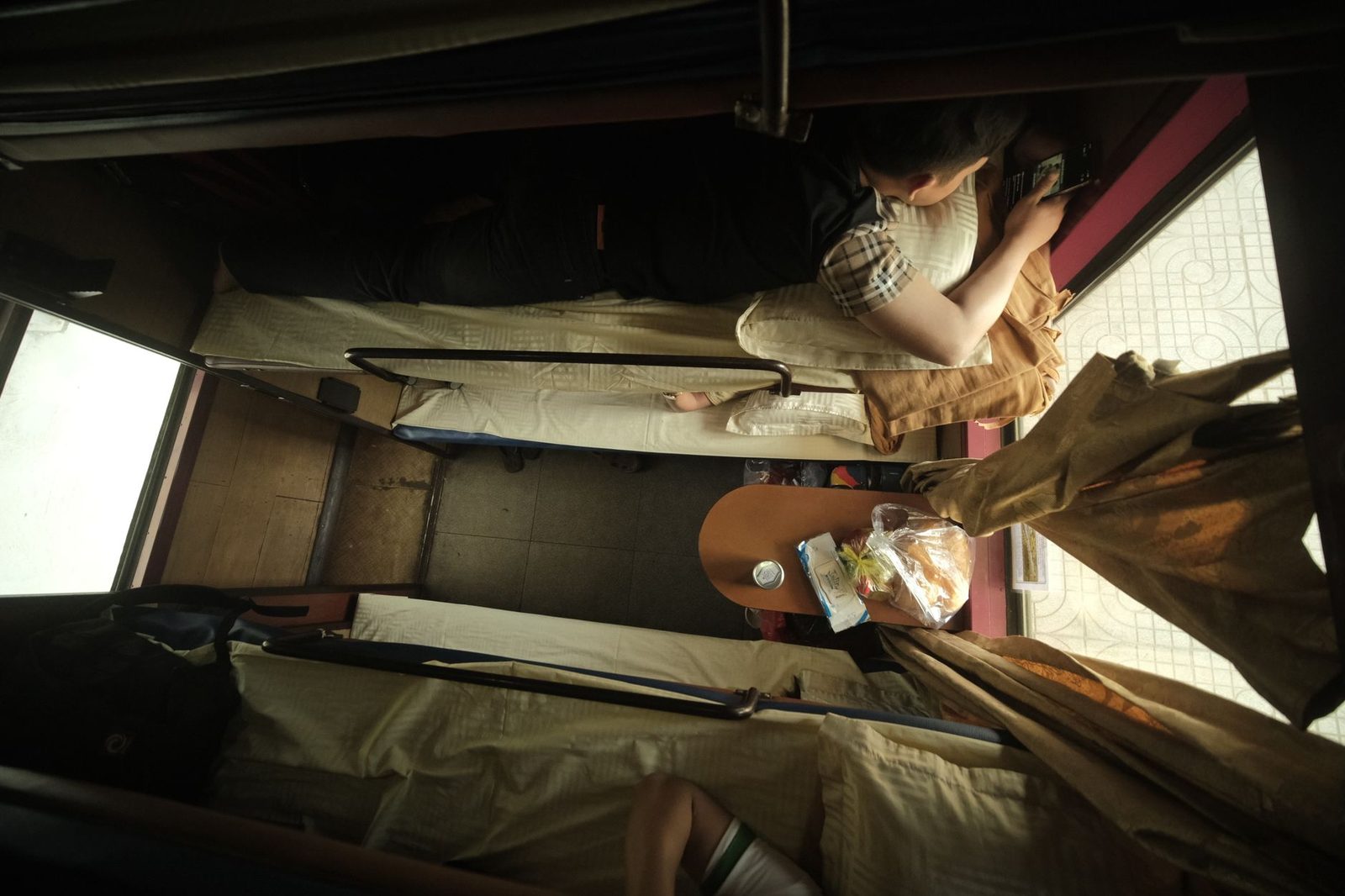
In a couchette or a night seat, your vigilance drops to zero for six hours. Couchette compartments lock from the inside (ÖBB Nightjet, European Sleeper, Snälltåget) and private cabins have a lock plus a safety latch. So the risk is concentrated in night seating and in unlocked couchette cars when someone boards en route.
- Slip your passport, bank card and cash into a money belt or a neck pouch worn under your clothes — that's the one thing that should never leave your body.
- Secure your suitcase to the foot of the bunk with a retractable security cable. A padlock on the zip won't stop the whole bag walking off: it's the cable that counts.
- Sleep with your head on the side where your luggage is, not your feet.
- If you're in a mixed couchette and that makes you uncomfortable, note that most operators (ÖBB, Trenitalia, European Sleeper, RegioJet) offer booking in a women-only compartment, often free of charge, and sometimes only bookable by phone or at the station: ask for it explicitly.
Platforms, passageways and connections after 10 p.m.
A station at midnight is a public space like any other. The rules are the same as in any city: stay in well-lit, busy areas, avoid underpasses and car parks, and use waiting lounges where they exist (DB Lounge, Sala Freccia, Salon Grand Voyageur — generally reserved for first class or cardholders, though a night-train ticket sometimes gets you in).
If your connection runs over an hour in the middle of the night, it's often better to pay for a luggage locker and go for a walk in a lively neighbourhood than to doze on a bench with your bags. And if you really do have to wait, a lightweight backpack lock looped around the leg of the bench lets you close your eyes without losing everything.
3. The solo traveller's kit: five items, no more
No need to kit yourself out as if for a trek. Effectiveness comes from consistency, not from the number of accessories.
| Need | Item | Why it works |
|---|---|---|
| Documents and money | Money belt or neck pouch | Stays on your body even when you're asleep |
| Main luggage | Security cable + small TSA padlock | Stops the whole bag being taken |
| Electronics | Power bank | A phone at 0% = no ticket, no map, no calls |
| Sleep | Sleep mask and earplugs | Actually sleeping cuts down next-day mistakes |
| Discretion | Plain backpack, no flashy logo | Doesn't advertise "well-equipped tourist" |
Two practical notes. First, a power bank isn't a comfort gadget but a safety item: half of all solo-travel nightmares begin with a dead phone — e-ticket included. Check its capacity in watt-hours if you're connecting to a flight (the usual limit is 100 Wh in the cabin). Second, duplicate everything: a photo of your passport in your email inbox, a paper copy of your tickets and your bank's emergency numbers in a different pocket from your phone.
For journeys over six hours, a neck travel pillow objectively improves sleep quality in a reclining seat — and a well-rested traveller is an attentive traveller.
4. The habits that matter more than the gear
Plan your arrival before you leave
The truly vulnerable moment isn't the train, it's walking out of the station at 11 p.m. in a city you don't know. Before departure:
- Work out the station → accommodation route, and what it costs by public transport and by official taxi.
- Write down the address in the local language (a driver will understand "Via dei Serpenti 12" better than your pronunciation).
- Download the offline map of the city.
- If you're arriving after midnight, consider shifting to another train or sleeping near the station for the first night.
Classic scams around the railways
- The fake official who offers to "validate" or "print" your ticket for a few euros in the concourse. Real staff wear a uniform and don't handle cash.
- Luggage help on the stairs: one person carries your suitcase to the top while another empties the outside pocket.
- The jostle at the barrier: you get crowded in a turnstile and relieved of your phone.
- The "nearest" cash machine pointed out by a helpful stranger: use ATMs inside banks or in monitored concourses.
- The fake ticket check as you get off the train, with a fine to be paid in cash. A real conductor always issues a receipt; insist on one.
Booking smartly when you travel alone
- Choose a reserved seat over an unreserved one: you know where you are, and so does the conductor.
- In couchette cars, lower berths are handier for keeping an eye on luggage; upper berths are quieter. Pick according to what worries you most.
- Avoid isolated seats at the end of the carriage, next to doors and toilets, on regional trains late in the evening: settle near the conductor or in the busiest carriage.
- On high-speed services in Spain and Italy, the low-cost trains (Ouigo, Avlo, Iryo, Italo) are very busy: paradoxically, that crowd is a form of protection.
5. A theft has happened: what to do, in order
This is where many travellers lose their rights, simply because they didn't do things in the right order.
- Tell the on-board staff immediately. Ask for the incident to be recorded and note the train number, the time and the station where it happened. In some countries, the train manager can request the railway police to attend at the next stop.
- File a report with the police of the country where the theft took place — they have jurisdiction, not the police where you live. Railway police: SUGE/Police nationale in France, Bundespolizei in Germany, Polfer in Italy, Policía Nacional / Mossos in Spain. Get the written receipt of your report: without it, no insurer will pay out.
- Block your bank cards and have the phone blocked (IMEI number — note it down before you leave).
- Lost ID documents: contact your country's consulate or embassy. An emergency travel document can be issued so you can get home.
- Notify your insurer within the deadline set out in your policy — often 5 working days, sometimes 48 hours for bank-card cover.
Who pays for what?
A key point, and one that is often misunderstood: in rail matters, EU Regulation 2021/782 on rail passengers' rights covers delays, cancellations, assistance and information — but it does not create any right to compensation for the theft of personal belongings. Hand luggage remains in your care. Carriers are only liable for unchecked luggage in very limited cases, essentially those linked to an accident.
In practice, then, your recourse runs through:
- Your bank card's insurance (Visa Premier, Gold Mastercard and above): "luggage theft and damage" and sometimes "theft of personal effects" cover, valid if the trip was paid for with the card. Read the limits, often €800 to €2,000, and the exclusions — cash and jewellery are almost always excluded.
- Your home insurance, which frequently includes an "property away from home" extension for IT equipment and glasses.
- Dedicated travel insurance, mainly worth it for long trips such as Interrail journeys where you're carrying high-value items.
A useful habit before you go: photograph the contents of your suitcase and keep the receipts for expensive gear in your cloud storage. A claim with no proof of value ends in a derisory offer.
6. Travelling alone as a woman: what changes, and what operators offer
Women travelling alone report fewer thefts than uncomfortable situations: persistence, staring, a neighbour who moves seats. There are ways to deal with it, and they're rarely explained at the ticket desk.
- Women-only compartments in couchette cars: offered by ÖBB Nightjet (the "Damenabteil" compartment), Trenitalia, RegioJet and several Central European operators. Tick the option when booking, or call.
- A private cabin: pricier, but it's the only genuine lock. On new-generation Nightjet trains, the single mini cabins bridge the price gap between a couchette and a single sleeper.
- Changing seats: you don't need to justify it. Just tell the conductor, who will find a solution or station themselves nearby.
- Emergency numbers: 112 works everywhere in the EU. In France, 31 17 (and the text line 31 177) is dedicated to violence and harassment on public transport; in Germany, the Bundespolizei has a station reporting app.
- Personal alarm: a small pull-pin pocket personal alarm, 90 dB and with no battery to worry about, deters without physical escalation and is legal everywhere.
7. The departure checklist (reread it ten minutes before your train)
- Documents, bank card and cash on your body, not in your bag.
- Main bag secured, labelled with an email address (not your home address).
- Ticket saved offline + paper copy.
- Phone charged, power bank in an outside pocket.
- Bank card-blocking numbers and IMEI noted somewhere other than your phone.
- Station → accommodation route known, offline map downloaded.
- Someone back home told your train number and arrival time.
Travelling solo by train in Europe isn't about armouring yourself, it's about eliminating the handful of scenarios that turn a hiccup into a disaster. A discreet belt, a cable around a suitcase, three seconds of looking up at every stop: the rest of the journey is yours, including the slightly selfish pleasure of watching the Alps roll by without having to make conversation.
Sources and useful references: European Union Agency for Railways (ERA, rail safety reports); Regulation (EU) 2021/782 on rail passengers' rights and obligations; Service statistique ministériel de la sécurité intérieure (SSMSI); general conditions of carriage of ÖBB Nightjet, European Sleeper, Trenitalia and SNCF Voyageurs; travel advice from the French Ministry for Europe and Foreign Affairs.