Short answer: in 2026 there is no direct Lisbon–Madrid train: the Trenhotel Lusitania has been suspended since March 2020 and has never been reinstated. The only genuine daily international train on the Portuguese side of the Iberian peninsula is the Celta, linking Porto (Campanhã) to Vigo (Guixar) in roughly 2 hr 15 min for €15 to €21, with two return services a day, jointly operated by CP – Comboios de Portugal and Renfe. For Lisbon–Madrid, the only truly practical option remains the direct coach (ALSA, FlixBus: 8 to 10 hours, €25 to €55) or flying (1 hr 15 min in the air, TAP / Iberia / Ryanair). By train, you have to accept a two- or three-leg itinerary via Entroncamento → Badajoz → Madrid on a Portuguese regional service that only runs a few days a week: technically possible, but best reserved for travellers who treat the journey as the point. Simple rule: rail for Porto–Vigo and Galicia, coach for Lisbon–Madrid and Andalusia, plane only if time is your number one criterion.
Spain and Portugal share 1,200 kilometres of border, a peninsula, a time zone offset of one hour… and almost no rail links at all. It is one of the most baffling anomalies of European travel: you can go from Vienna to Belgrade by direct train, from Prague to Copenhagen, from Brussels to Milan in a sleeper berth — but not from Lisbon to Madrid without switching transport mode or stacking up connections.
This guide sets out what you can actually book today between the two countries: the trains that run, the coaches that have replaced them, the prices observed, the journey times, and the booking traps specific to this border.
1. Why the Iberian border is a railway black hole
Three reasons pile up, and none of them is going away quickly.
Track gauge. Spain and Portugal have historically used Iberian gauge (1,668 mm), different from the European standard (1,435 mm). But Spain is building its high-speed network in standard gauge, which creates a break within the peninsula itself: a Portuguese Iberian-gauge train cannot run on Spanish AVE lines without changing axles.
The geography of the lines. Portugal's major cities sit on the Atlantic seaboard, Spain's major cities in the centre and along the Mediterranean. In between: Extremadura and the Alentejo, among the least densely populated regions in Western Europe. Few travellers, so few trains, so poorly maintained lines, so even fewer travellers.
The pandemic, which served as a pretext. The two Trenhotel night trains, the Lusitania (Lisbon–Madrid) and the Sud Expresso (Lisbon–Hendaye, via the French border), were suspended in March 2020. Six years on, they still have not come back and neither CP nor Renfe has announced any date for sales to open. This is not a technical delay: it is abandonment in all but name.
Key takeaway: in the Iberian peninsula, coaches have taken over the space rail left empty. It isn't the traveller's choice — it's the state of the network.
2. The Porto–Vigo Celta: the only genuine international train
This is the link that works, and the one worth knowing about.
| Item | 2026 detail |
|---|---|
| Operators | CP + Renfe (joint operation) |
| Stations | Porto Campanhã ↔ Vigo Guixar |
| Duration | ≈ 2 hr 15 min |
| Frequency | 2 return services per day |
| Indicative price | €15 to €21 one way |
| Stops | Nine, Viana do Castelo, Valença, Tui, Guillarey, Redondela |
| Booking | cp.pt, renfe.com, ticket offices |
A few practical points that make all the difference:
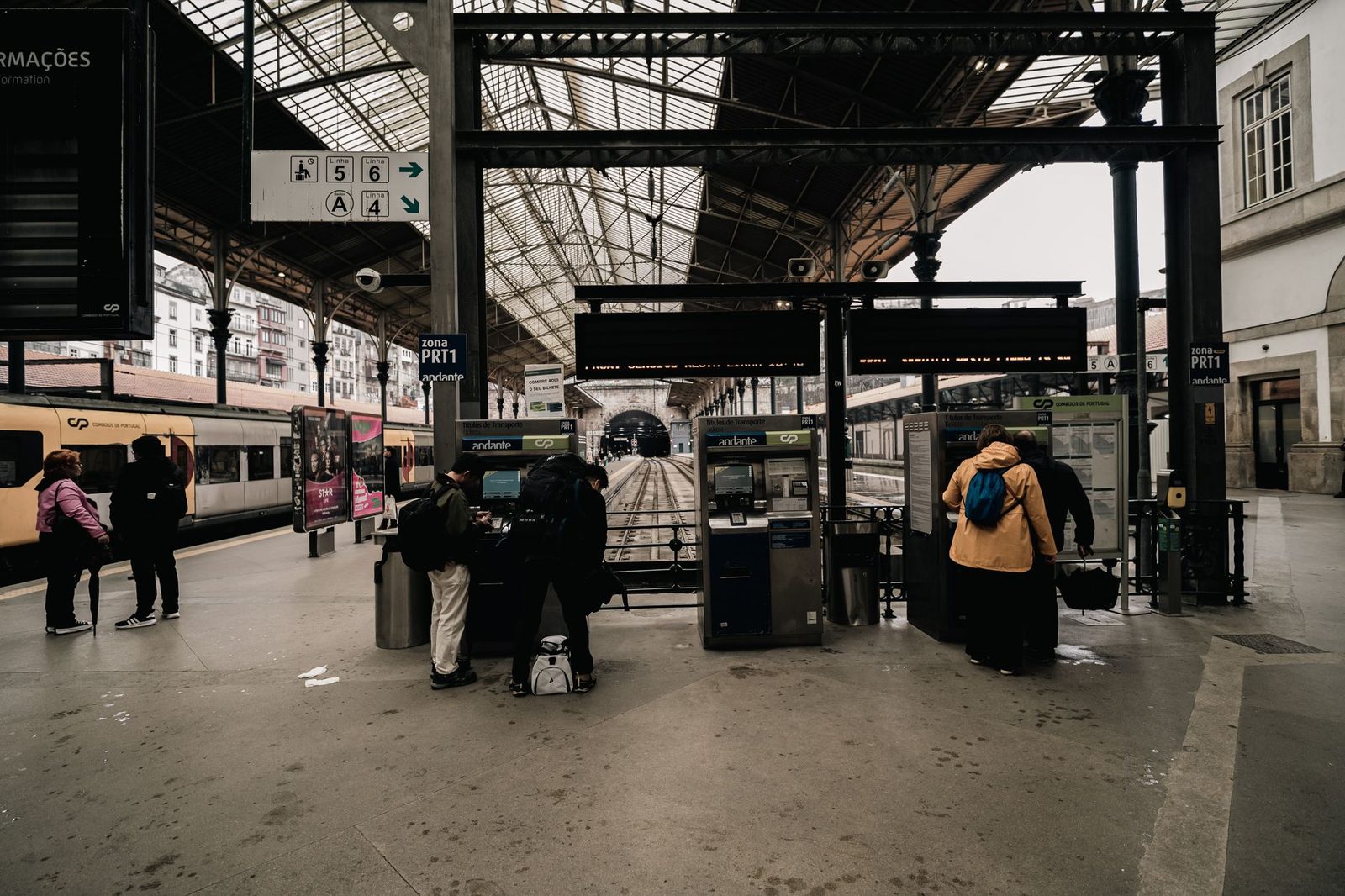
- Vigo has two stations. The Celta arrives at Vigo-Guixar, not Vigo-Urzáiz, which is where the Avant and Alvia trains leave from for Santiago de Compostela and Madrid. The two stations are about 2 km apart, with a decent climb in between. Allow 25 minutes on foot, or take a city bus / taxi. Never plan a 20-minute connection between the two.
- The time change. Portugal is one hour behind Spain. A departure from Porto at 08:13 arrives in Vigo at 11:28 Spanish local time: the actual journey time really is 2 hr 15 min, but the display catches out the inattentive traveller. It's the number one cause of missed trains on this line.
- A useful connection. At Vigo-Urzáiz, regional and Avant trains run to Santiago and A Coruña; from there, Renfe's Alvia services reach Madrid-Chamartín in 4 to 4.5 hours. Porto → Madrid by this route: doable in a single day, but around 9 to 11 hours door to door.
- Luggage. As on most Iberian trains, there is no strict weight limit, but space is tight on the Celta. If you're linking connections on foot between Guixar and Urzáiz, a wheeled cabin suitcase beats an improvised large hold bag.
3. Lisbon–Madrid: the three options, honestly compared
This is the question everyone asks. Here are the three answers.
The direct coach: the default solution
ALSA and FlixBus run direct Lisbon–Madrid services, including overnight departures. Allow 8 to 10 hours of travel and €25 to €55 depending on how far ahead you book, with fares dipping below €20 in low season. Arrival is usually at Madrid–Méndez Álvaro, a coach hub connected to the metro (line 6) and the Cercanías network.
Pros: direct, hold luggage included, daily frequency, predictable pricing. Cons: a night in a reclining seat is not a berth. If you take an overnight departure, an eye mask and earplugs will literally transform the quality of your night — the same instinct applies as on a night train, as detailed in our guide to sleeping well on a night train. For everything about how ALSA works on the Spanish side, also see our feature Alsa in Spain: routes, prices and booking.
The train in segments: for enthusiasts
The rail route does exist, but it takes some planning:
- Lisbon (Oriente or Santa Apolónia) → Entroncamento, CP Intercidades and Alfa Pendular trains, very frequent, about 1 hour.
- Entroncamento → Badajoz, a CP regional service crossing the Alentejo via Abrantes and Elvas. This is the fragile link: reduced frequency, not daily depending on the season, awkward timings.
- Badajoz → Madrid-Atocha, Renfe Alvia trains, roughly 4 to 4.5 hours via Mérida and Cáceres, on an Extremadura line modernised in sections.
Realistic total: 10 to 14 hours including waits, for a cost often comparable to the coach. You don't do it to go fast, you do it to cross the Alentejo and Extremadura, which are magnificent. Check the Entroncamento–Badajoz leg timetable on cp.pt without fail before locking anything in: that leg decides whether the trip is feasible at all.
Flying: 1 hr 15 min in the air, 4 hours door to door
TAP Air Portugal, Iberia and Ryanair link Lisbon to Madrid several times a day. The flight takes about 1 hr 15 min, but between airport transfers, security and waiting, door to door works out at around 4 hours. On this particular route — unlike Paris–London — the plane retains a clear time advantage, which explains its dominance. Our comparison train or plane in Europe explains the calculation method.
4. The other border crossings that genuinely exist
Beyond Porto–Vigo and Lisbon–Madrid, three corridors are worth knowing.
North: Valença ↔ Tui, on foot if need be
The Minho border is crossed on the international bridge between Valença do Minho (Portugal) and Tui (Galicia). The Celta stops on both sides, but you can also reach Valença on a CP regional train from Porto, walk across the bridge (a few hundred metres — it's a classic stage of the Camino Português), then catch a Galician bus to Vigo or Santiago. This is the pilgrims' option, and the choice of travellers without an international ticket.
South: Algarve ↔ Seville and Huelva
No trains at all. The link is by coach, mainly between Faro / Lagos / Albufeira and Seville, via the Guadiana bridge. Allow roughly 2 hr 45 min to 3 hr 30 min and €20 to €30. It is one of the most heavily used cross-border routes in the peninsula, with several daily departures in summer and a reduced service in winter. For arrivals at Seville airport, the feeder-coach logic is the same as described in our article on the direct coach from Seville airport to Porto.
East: Porto / Lisbon ↔ Salamanca and Castile
The Porto–Vilar Formoso–Salamanca road axis is served by coach (ALSA, FlixBus and Portuguese operators). Allow 5 to 6 hours from Porto. On the rail side, the Beira Alta line has been refurbished on the Portuguese side, but with no regular international passenger service on sale for now.
5. Booking without falling into traps: six rules
- One ticket per country, usually. Except on the Celta, there is no single through ticket between Portugal and Spain. Two tickets = two contracts = no protection if the first leg runs late. The principle is the same as the one explained in our guide to missed train connections.
- Allow 90 minutes of buffer at every change of operator or country. Not 20, not 30.
- Never forget the time difference. Portugal = UTC+1 in summer, Spain = UTC+2. One hour's difference, in both directions.
- Buy early on the Renfe side. The Badajoz–Madrid and Vigo–Madrid Alvia services use yield pricing: the Básico and Elige fares go fast. The Celta, by contrast, barely fluctuates.
- Check the exact station. Lisbon has Oriente and Santa Apolónia; Madrid has Atocha and Chamartín; Vigo has Guixar and Urzáiz; Porto has Campanhã and São Bento. Getting the station wrong costs more than the ticket.
- Off-grid, plan for self-sufficiency. Across the Alentejo and Extremadura, mobile coverage is patchy and regional trains have neither Wi-Fi nor reliable power sockets. A 20,000 mAh power bank and offline PDF tickets will spare you a panic at the ticket check. For connectivity, see our guide to Wi-Fi and mobile data on trains and buses.
6. Cards and passes: what helps, what doesn't
- Interrail / Eurail covers CP and Renfe, but Spanish Alvia and AVE services require a compulsory paid reservation (often €10 to €20 per journey), and pass quotas are limited. On a peninsula where coaches dominate, a pass is rarely worth it: our analysis of when Interrail really pays off applies here to the letter.
- Tarjeta Dorada (Renfe): useful for seniors on the Spanish legs (Badajoz–Madrid, Vigo–Madrid). Details in our feature on senior railcards in Europe and on the discount cards page.
- On the CP side, discounts are mostly tied to age and advance purchase on Alfa Pendular and Intercidades services; they do not apply to the Celta in the same way.
- A printed Portugal travel guide remains surprisingly useful on this axis: regional Alentejo timetables are not always reliable in aggregator apps, and intermediate stations have neither staff nor up-to-date displays.
7. And tomorrow? What's been announced, what's bookable
The Portuguese government is pushing a Lisbon–Porto high-speed line, then Porto–Vigo, and the two states regularly float a high-speed Lisbon–Madrid link for the 2030–2034 horizon. The Porto–Vigo section features among the priority corridors of the Trans-European Transport Network (TEN-T).
But for a traveller booking today, the only thing that counts is what's on sale. And that hasn't changed: Celta, coaches, plane. As long as the Lusitania isn't open for booking on renfe.com or cp.pt, it doesn't exist.
Frequently asked questions
Is there a direct Lisbon–Madrid train in 2026?
No. The Trenhotel Lusitania night train has been suspended since March 2020 and has not returned to sale. The options are the direct coach (8 to 10 hours), flying (1 hr 15 min in the air) or a two- or three-leg rail itinerary via Entroncamento and Badajoz.
How much does the Porto–Vigo train cost?
Around €15 to €21 one way on the Celta, for a 2 hr 15 min journey with two return services a day. Fares are stable: no need to book months ahead, unlike the Spanish Alvia trains.
Does the Sud Expresso Lisbon–Hendaye still run?
No. Like the Lusitania, it was suspended in 2020. To reach France from Portugal by train, you have to go via Vigo, then Madrid or the Galician network, then Barcelona or Irún — or take a direct coach.
Do you need a passport to travel from Portugal to Spain?
No: both countries are in the Schengen area, so there are no systematic checks. A valid ID document is enough, and remains mandatory for spot identity checks. Non-EU nationals, meanwhile, are subject to EES and ETIAS rules when entering the Schengen area.
Can you take a bike from Portugal to Spain by train?
On the Celta, carrying bikes is possible under limited conditions that vary with the rolling stock on the day — a folding bike, accepted as luggage, is a safer bet. The rules for each operator are detailed in our guide to bikes and trains in Europe.
In summary
- Porto–Vigo on the Celta: the only reliable, affordable international rail link (2 hr 15 min, €15–21, 2 return services a day).
- Lisbon–Madrid: no direct train since 2020. ALSA/FlixBus coach (8–10 hours, €25–55) or plane (1 hr 15 min in the air).
- Algarve–Seville: coach only, 2 hr 45 min to 3 hr 30 min, €20–30.
- Watch out for same-name stations (Vigo Guixar / Urzáiz, Madrid Atocha / Chamartín) and the one-hour time difference between the two countries.
- Separate tickets = separate risk: a minimum 90-minute buffer at every change of country.
- Iberian high-speed projects are real but not bookable: plan with the service that exists, not with the announcements.
To compare trains, coaches and ridesharing on the same Iberian route, run a search on Gopaxo or browse our carrier profiles and our route information.