Short answer: in Portugal, the train is excellent on one single axis, the Linha do Norte Lisbon–Coimbra–Porto, where the Alfa Pendular run by CP (Comboios de Portugal) takes 2 hr 50 min to 3 hr and the Intercidades 3 hr 10 min to 3 hr 30 min, with Promo tickets from €14–20 if you book 5 to 8 days ahead (against €32–45 in full-fare 2nd class). Everywhere else — the interior, the Alentejo, cross-country links, local服务 in the Algarve — the coach wins: Rede Expressos (the national network), FlixBus and EVA/Frota Azul connect Lisbon to Faro in 3 hr 30 min for €20–25 and serve dozens of towns with no station. Golden rule: in Portugal, buy train tickets well in advance (Promo fares sell out fast and are capped) and coach tickets on the day, stress-free (coaches are rarely full outside long bank-holiday weekends and the month of August).
Portugal is the country in Western Europe where French-speaking travellers most often pick the wrong mode. You arrive with the French reflex — "there must be a train" — and discover that the Portuguese rail network, after decades of line closures, boils down to a very efficient north–south backbone and a handful of branches. Between Évora and Faro, between Bragança and Porto, between Nazaré and Lisbon, the train doesn't exist or no longer exists: it's the coach that holds the country together.
The opposite is true as well. Many travellers automatically take the coach because someone told them "Portuguese trains are slow", and they pay €22 to do Lisbon–Porto in 3 hr 30 min on the road when the Alfa Pendular would have covered the same route in 2 hr 50 min for €19 on a Promo fare.
This guide reviews, operator by operator and axis by axis, what is actually bookable in November 2026, ahead of the European timetable change of 13 December 2026.
1. Understanding CP's rail offer
There is only one long-distance operator in Portugal: CP – Comboios de Portugal, a state-owned company. No private competition as in Spain or Italy, so no price war — but a very generous promotional fare system for those who book early.
Four products to know:
| Product | Use | Speed | Reservation |
|---|---|---|---|
| Alfa Pendular (AP) | Faro–Lisbon–Coimbra–Porto–Braga | The fastest, tilting train | Compulsory, assigned seat |
| Intercidades (IC) | North, Alentejo, Algarve, Beira Alta | 20–40 min slower than the AP | Compulsory, assigned seat |
| Urbanos / Regional | Lisbon, Porto, local lines | All stations | No reservation |
| Celta / international | Porto–Vigo (Spain) | Cross-border regional | No reservation |
The crucial point: on the Alfa Pendular and the Intercidades, CP sells Promo tickets (roughly 25 to 65% off depending on how full the train is) that open up to 60 days before departure. They are capped: on a Friday evening Lisbon–Porto, there are often none left 48 hours out. On a Tuesday morning in February, some are still available the day before.
Second point: CP applies a 25% discount on tickets bought online at least 5 days in advance (the "Antecipada" fare), which can't be combined with anything, but is often the best option once Promo fares are gone.
Third point, always worth checking: CP also offers a Cartão Jovem (youth card) and discounts for the over-65s (around 50% on presentation of ID), with no paid card to buy. If you fall into one of those age brackets, both the ticket office and the website apply the reduction directly — a rare case in Europe, where you usually have to pay for a card. We cover the European equivalents in our comparison of senior rail cards in Europe.
Keep in mind: CP does not price by time of day the way SNCF does. The fare depends almost entirely on when you buy and how full the train is.
2. Lisbon–Porto: the axis where the train clearly wins
This is the most popular journey in the country, and the only one where rail is clearly superior.
By Alfa Pendular: 2 hr 50 min to 3 hr between Lisboa Oriente (or Santa Apolónia) and Porto Campanhã, stopping at Coimbra-B and sometimes Aveiro. Around ten round trips a day. 2026 fares: reckon on €14–22 on Promo, €26–32 on Antecipada, €32–36 in full-fare 2nd class (Turística), €45–50 in 1st class (Conforto), which includes a snack served at your seat.
By Intercidades: 3 hr 10 min to 3 hr 30 min, the same stations plus a few intermediate stops, about €5 less than the AP in the same time slot. If the price gap is under €4, take the AP.
By coach: Rede Expressos and FlixBus run Lisbon (Sete Rios) – Porto in 3 hr 20 min to 3 hr 45 min for €12 to €22. It's competitive on price, not on time, and certainly not on comfort over 3 hr 30 min on the A1 motorway.
The Lisbon station trap. Long-distance trains leave from two different stations depending on the departure time: Santa Apolónia (city centre, on the Tagus waterfront) and Lisboa Oriente (Gare do Oriente, Parque das Nações district, red metro line interchange). All northbound AP and IC services call at Oriente; only some continue to Santa Apolónia. Check your departure station on the ticket: they are two different metro stops, 15 minutes apart.
The Porto trap. Long-distance trains arrive at Campanhã, not São Bento (the azulejo-tiled station in the city centre). The suburban shuttle Campanhã → São Bento takes 5 minutes and is included in most long-distance tickets: keep your ticket and validate it at the machine.
Portuguese platforms are long, underpasses numerous, and historic stations generous with steps. On this axis as elsewhere in the peninsula, a hard-shell four-wheel cabin suitcase handles far better than a stiff travel bag slung over your shoulder.
3. The Algarve: train for the long haul, coach for local travel
Two completely different logics.
To get from Lisbon down to Faro, the train is comfortable: Alfa Pendular in 2 hr 55 min to 3 hr 05 min, Intercidades in 3 hr 15 min to 3 hr 30 min, from €15 on Promo to around €24.70 at full 2nd-class fare. The train crosses the Tagus on the 25 de Abril bridge (via the southern line) and runs through the Alentejo. By coach, Rede Expressos and EVA link Lisbon with Faro, Albufeira, Lagos and Portimão in 3 hr 15 min to 4 hr for €20–25.
To get around within the Algarve, it's the other way round. The Linha do Algarve (Lagos–Faro–Vila Real de Santo António) is a slow but extremely cheap regional line: €2 to €8 depending on distance, no reservation, a train every 1 to 2 hours. Faro–Lagos takes about 1 hr 40 min. Stations are often 1 or 2 km from the beaches and the old town (Albufeira is the textbook case: the station is 6 km from the centre). The EVA Transportes and Frota Azul coaches serve the town centres and seaside resorts the train ignores.
Towards Spain: from Vila Real de Santo António, the ferry crosses the Guadiana to Ayamonte, where you pick up a Damas coach to Huelva and Seville. For a direct coach, FlixBus and Alsa link Faro or Lagos with Seville in 4 hr 30 min to 5 hr 30 min. We cover Iberian border crossings in detail in our guide Portugal–Spain: CP, Renfe, Celta and buses.
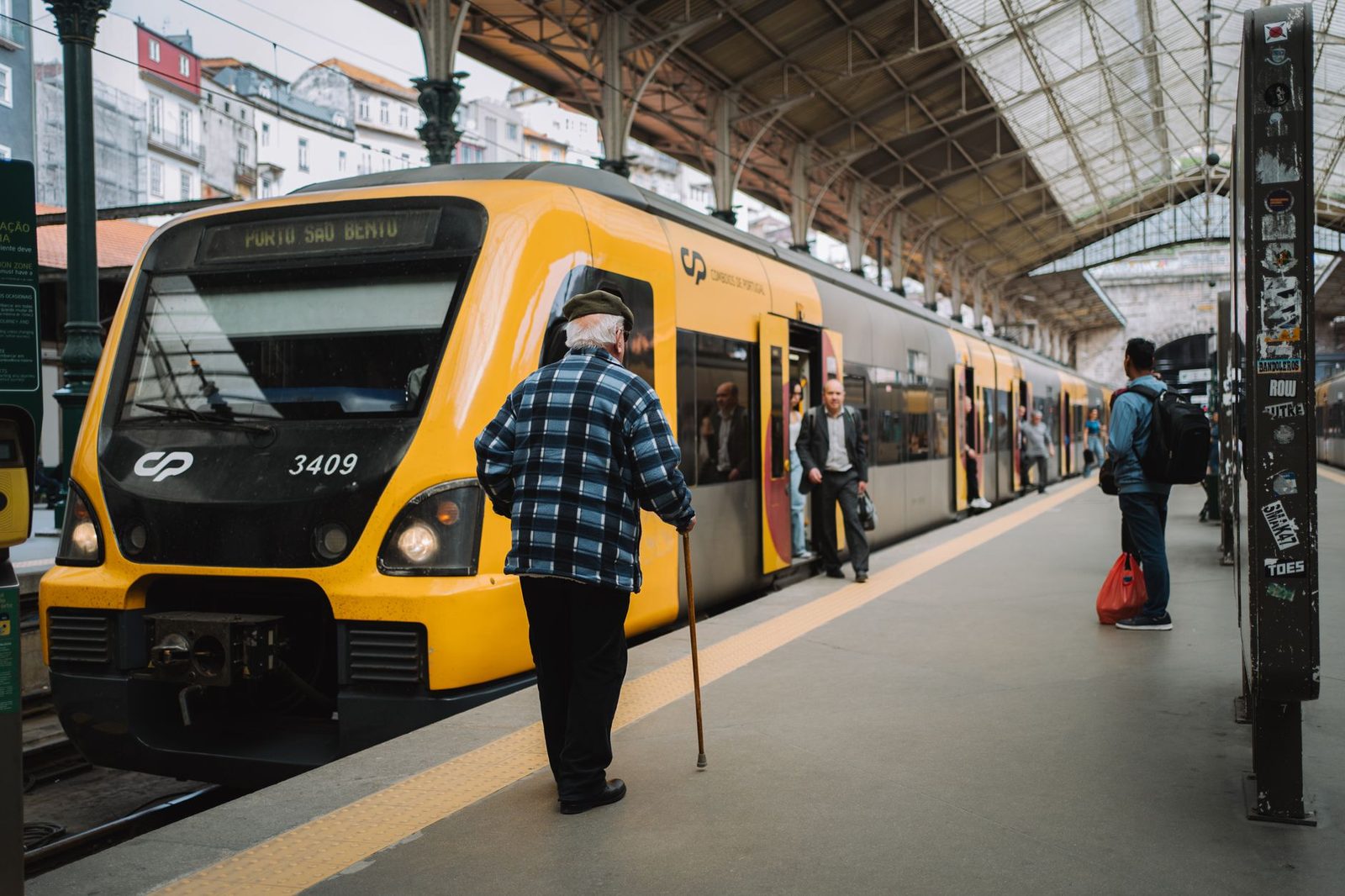
4. Rede Expressos, FlixBus and the regional networks
Rede Expressos is Portugal's true national network: more than 450 destinations, one hub at Lisbon Sete Rios and another in Porto at Casa da Música / Campo 24 de Agosto. It's the operator to open first as soon as your destination isn't on the Linha do Norte: Évora, Beja, Castelo Branco, Guarda, Bragança, Viseu, Leiria, Nazaré, Fátima, Peniche.
Ballpark figures bookable in November 2026:
| Route | Mode | Duration | Indicative price |
|---|---|---|---|
| Lisbon → Porto | Alfa Pendular | 2 hr 50 min | €14–36 |
| Lisbon → Porto | Rede Expressos / FlixBus | 3 hr 30 min | €12–22 |
| Lisbon → Faro | Intercidades | 3 hr 20 min | €15–25 |
| Lisbon → Évora | Rede Expressos | 1 hr 40 min | €12–14 |
| Lisbon → Nazaré | Rede Expressos | 1 hr 50 min | €11–13 |
| Porto → Braga | CP Urbanos | 1 hr 05 min | approx. €3.80 |
| Porto → Guimarães | CP Urbanos | 1 hr 15 min | approx. €3.80 |
| Porto → Bragança | Rede Expressos | 3 hr 45 min | €18–22 |
| Lisbon → Madrid | FlixBus / Alsa | 9–10 hr | €35–55 |
FlixBus has a tighter Portuguese network (Lisbon, Porto, Coimbra, Braga, Faro, Albufeira, Lagos) but excels on international routes to Spain and France, with very low headline prices midweek. Luggage rules differ from the train's: one checked bag up to 20 kg included with FlixBus, one piece of hand luggage, and surcharges for a second bag. The company-by-company breakdown is in our guide to luggage on trains, buses and planes in Europe.
For overnight journeys to Madrid or the south of France (9 hr and more), a neck travel pillow and a blackout sleep mask make a real difference: coach cabin lighting stays on at border stops.
5. The Douro, the Beira and the scenic lines
Portugal has kept two regional lines that are worth the trip for their own sake, and both can be taken without a reservation, at the regional fare.
The Linha do Douro, from Porto São Bento to Pocinho, follows the Douro river for more than 100 km through the UNESCO-listed terraced vineyards. Allow about 3 hr 30 min to Pocinho and under €15 one way on a regional train. The finest stretch is between Mosteirô and Tua. Sit on the right-hand side travelling Porto → Pocinho. Roughly one train every 2 hours, worth checking on CP's website as the service varies between weekdays and weekends.
The Linha da Beira Alta, Coimbra–Guarda–Vilar Formoso, links Portugal to the Spanish border. It has been the subject of major modernisation works carried out by Infraestruturas de Portugal, with recurring bus-replacement phases since 2023: before planning it, check the engineering notices on cp.pt.
The Linha do Vouga, the country's last metre-gauge line between Espinho, Aveiro and Sernada do Vouga, survives on a reduced service — a railway curiosity rather than a transport tool.
On these regional lines, mobile coverage is patchy in the deep valleys: a printed Portugal travel guide and offline downloaded maps will spare you an unpleasant surprise. See also our rundown on Wi-Fi and mobile data on trains and buses in Europe.
6. Lisbon and Porto: the city cards that change the bill
Two separate systems, two rechargeable plastic cards to buy once.
In Lisbon, the Navegante Ocasional card costs €0.50 and can be loaded either with "zapping" (pay-per-trip credit) or with 24 hours of unlimited travel. A single metro ticket costs around €1.80 with the card, against €2.10 on board buses without one. The 24-hour Carris/Metro pass is around €7 and pays off from 4 trips, especially if you use trams 28 and 15 and the lifts (the Elevador de Santa Justa alone costs €6.50 as a standalone ticket, but is included in the pass). Note: CP Urbanos trains to Cascais, Sintra and the south bank can be bought on the same card but are not covered by the basic Carris/Metro pass.
In Porto, the Andante card costs €0.60 and works by zones (Z2, Z3, Z4…): a Z2 journey covers the centre for about €1.40, and the airport is in Z4 (around €2.25). There is also an urban Andante 24. Porto's metro links Francisco Sá Carneiro airport to the centre in 30 minutes on line E (purple) — one of the best price/time ratios in Europe for an airport link.
At Lisbon airport, the metro (red line) reaches Gare do Oriente in 5 minutes and the centre in 25–30 minutes, at the standard urban fare. The "Aerobus" shuttles have had little point since the metro started serving the terminal.
To compare options on a specific route, compare on Gopaxo the trains, coaches and ridesharing available on your chosen date, and check the carrier profiles before booking.
7. What changes at the timetable change of 13 December 2026
As everywhere in Europe, CP adjusts its timetables at the annual timetable change on 13 December 2026. Three things to watch:
- Works on the Linha do Norte and the Beira Alta continue to force occasional bus replacements, especially at weekends. Night services are the first to be affected.
- CP's fares are revised at the start of each calendar year by government decision; the Promo fare bands change accordingly. Booking before the switch offers no particular advantage: the price is locked in at purchase, that's all.
- Coaches have no timetable change: Rede Expressos and FlixBus adjust frequencies continuously, with a marked dip in January–February and a peak in August.
The Europe-wide detail is in our article on the timetable change of 13 December 2026.
8. The method in five reflexes
- Is your journey on the Linha do Norte (Lisbon–Coimbra–Aveiro–Porto–Braga) or on the southern axis towards Faro? If so, open CP first. If not, open Rede Expressos.
- Book the train 5 to 10 days ahead to catch a Promo or the Antecipada at −25%. Beyond 60 days, sales aren't open yet.
- Check the station, not just the city: Oriente or Santa Apolónia in Lisbon, Campanhã or São Bento in Porto.
- Buy the city card on arrival: Navegante in Lisbon, Andante in Porto. The single-ticket premium pays for the card within two trips.
- For the Douro and local Algarve travel, book nothing: hop on, pay the regional fare, and keep your flexibility.
Frequently asked questions
Are reservations compulsory on trains in Portugal?
Yes for the Alfa Pendular and the Intercidades: the seat is assigned and the train can sell out. No for Regional and Urbanos services (Douro, Algarve, Sintra, Cascais, Braga, Guimarães), where you buy at the ticket office or machine on the day.
Is the Interrail pass valid in Portugal?
Yes, Portugal is within the Interrail/Eurail area. But the Alfa Pendular and Intercidades require a paid reservation (a few euros), to be made at a station or by phone, and the network is small: the pass mainly makes sense within a broader Iberian itinerary. See our analysis of whether the Interrail pass pays off.
What's the best way to get from Lisbon to Seville?
The coach. FlixBus and Alsa link Lisbon with Seville in 6 hr 30 min to 8 hr for €25 to €45, with a few overnight departures. There is no direct train between Lisbon and Seville: by rail you have to go via Badajoz or via Faro and the Guadiana, with two to three changes and a whole day of travel.
Can you take a bike on Portuguese trains?
On Regional and Urbanos services, yes, free of charge, in the marked spaces, subject to room. On the Alfa Pendular, an assembled bike is not accepted; on Intercidades, some trainsets have spaces available with a reservation. A carrying bag for a dismantled bike solves the problem on every train. Our guide sets out the European rules in taking your bike on the train in Europe.
Are Portuguese trains punctual?
The Alfa Pendular posts good punctuality rates on the Linha do Norte. Delays mostly come from Infraestruturas de Portugal worksites and from industrial action, which is frequent at CP. In the event of a significant delay, European passenger rights apply: see your rights and compensation in Europe.
In summary
- Lisbon–Porto: take the train. Alfa Pendular in 2 hr 50 min, Promo fares from €14–22, far more comfortable than the A1 by coach.
- Lisbon–Faro: train or coach, both work. 3 hr 20 min and €15–25 on the Intercidades, 3 hr 15 min–4 hr and €20–25 by coach.
- Everywhere else: the coach. Rede Expressos covers 450 destinations the railways abandoned (Évora, Nazaré, Bragança, Fátima).
- Book the train early, the coach late. CP's Promo fares are capped; coaches are rarely full outside August.
- Two stations in Lisbon, two in Porto: Oriente/Santa Apolónia and Campanhã/São Bento. The Campanhã–São Bento shuttle is included.
- City cards are essential: Navegante (€0.50) in Lisbon, Andante (€0.60) in Porto, Porto airport in zone Z4.
- The Douro and local Algarve lines are taken at the regional fare, with no reservation, for a few euros.
Official sources: timetables and fares on cp.pt, network and works on infraestruturasdeportugal.pt, coach network on rede-expressos.pt, urban transport on metrolisboa.pt and metrodoporto.pt.